Understanding Ear Cropping in Doberman Pinschers

Updated: Dec 7, 2025
More Than Just Aesthetics
Author: Emilie Campbell, BSN-RN, Professional Breeder & Pack Leader
Campbell’s Family Dobermans
Editorial Support: Cassie Higgins, Voice Architect — Discovery Loft
The Belief

There’s a common assumption that ear cropping in Dobermans is done purely for cosmetic reasons.
In reality, the practice is deeply rooted in the functional design of the breed.
The Doberman Pinscher is the only dog in the world specifically created for personal protection of a human being—not a home, not a yard, but the individual themselves. Every structural element of the breed, including cropped ears and a docked tail, was intentionally developed to support that purpose and to enhance the safety of both the dog and the person they protect.
Why Ear Cropping Became Part of the Breed Standard
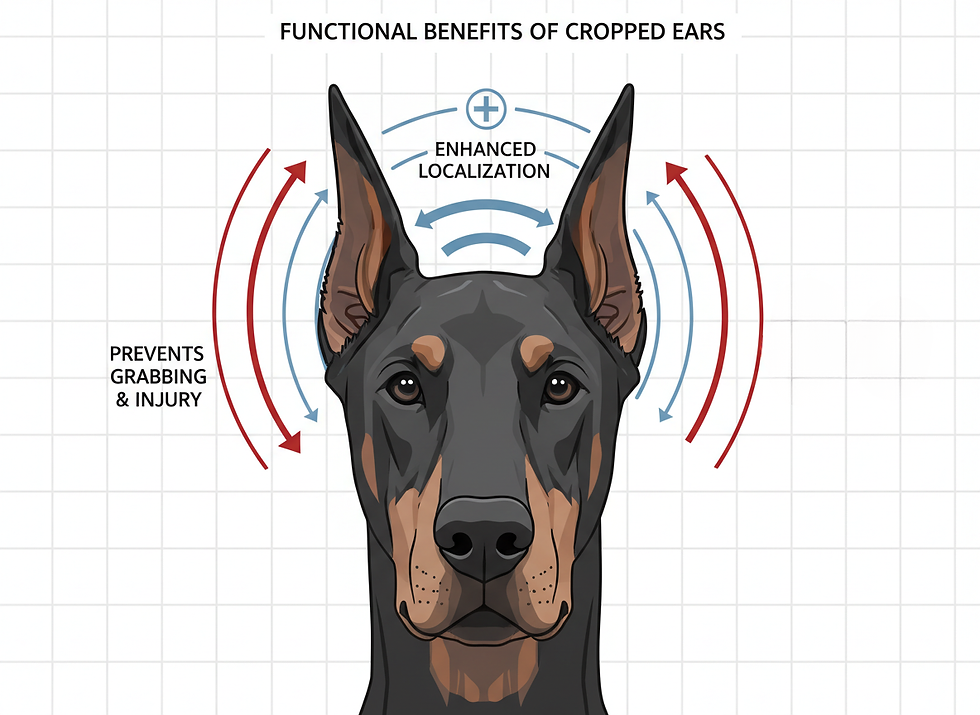
Ear cropping has been included in the Doberman standard since the breed’s origin because it enhances performance and reduces vulnerability in protection work.
In high-stakes situations, long, pendulous ears are a significant liability.
A perpetrator can grab, twist, or tear the ears, causing pain and disorientation—exactly the kind of interruption that can compromise a protection dog’s ability to stay engaged and defend effectively.
Cropped ears eliminate this weak point and allow the Doberman to remain fully focused on the task at hand: protecting the person they are bonded to.
Additionally, erect ears improve sound localization and directional awareness—a critical asset for a breed designed to detect and respond to threats. This is why most working dogs with natural upright ears — Belgian Malinois, German Shepherds, Dutch Shepherds — have similar ear structure.
The Functional Role of a Docked Tail

The Doberman’s natural tail is long, thin, and vulnerable to injury.
In protection work or any high-speed movement, the tail can be grabbed, twisted, or used as leverage by an attacker. It is also prone to “happy tail” injuries, where repeated impact causes the tip to split—sometimes requiring surgical correction.
Docking reduces these risks and protects the dog in the environments the Doberman was designed to operate in.
Preserving the Function of the Breed

Ear cropping and tail docking are not aesthetic decisions—they are functional ones.
While many Dobermans today are family companions, the breed standard exists to preserve their:
structure
purpose
capability
and original functional integrity
When standards shift to accommodate trends rather than function, the defining characteristics of a breed can slowly erode.
Maintaining the Doberman standard ensures that future generations retain the athleticism, drive, and protective instincts they were created for—even if an individual dog never enters formal protection work.
Final Thoughts

A Doberman is not just another breed.
It is a purpose-bred protector—intelligent, loyal, intuitive, and designed with intention.
Ear cropping and tail docking have been essential components of the Doberman’s functional design since the breed’s creation. Whether a Doberman today works in protection, performance, service roles, or simply serves as a beloved family companion, maintaining the standard ensures the breed continues to embody the clarity, strength, and purpose it was built for.
– Emilie Campbell
Campbell’s Family Dobermans
Copyright & Use
© 2025 Campbell’s Family Dobermans. All rights reserved.
Original content written by Emilie Campbell. Editorial support by Discovery Loft for clarity and narrative structure.
This article contains original educational material and intellectual property belonging to Campbell’s Family Dobermans.
No portion of this content may be copied, reproduced, distributed, or republished without explicit written permission from the author.
Sharing the direct link to this published article is welcome.
Claiming the concepts, writing, or explanations as your own is not.


Comments